
Places > Florence
The Institute and Museum of the History of Science (IMSS)
Florence, Piazza de' Giudici 1
Founded
in 1927 at the initiative of the University of Florence, the IMSS played a
determinant role in the realization of the First National Exposition of the
History of Science held in Florence in 1929. The first exhibition halls in the IMSS
were opened to the public in
The
collections of scientific instruments belonging to the Florence Institute and
Museum of the History of Science are among the world's most important. These
collections offer eloquent testimony of the scientific research sponsored first
by members of the Medici dynasty, and then by the Grand Dukes of Lorraine.
Starting with Cosimo I, the Medici Grand Dukes collected instruments of extraordinary
beauty and innovative concept. The Medicean scientific collection was first
kept in the Sala delle Carte in Palazzo Vecchio, and moved later to the
Stanzino delle Matematiche and the adjacent Sala delle Matematiche in the
Uffizi Gallery. Continuously enriched, these collections remained in the
Gallery, alongside masterpieces of figurative art and of the most bizarre
natural wonders, up to the mid-18th century, when the scientific collections
were separated from the artistic ones.
Transferred
to the Museum of Physics and Natural History, founded by Grand Duke Peter
Leopold in 1775, the Medicean scientific collections were enriched by
conspicuous acquisitions of new instruments and experimental apparatus. The
Museum of Physics became, under its first director, Felice Fontana, an
important structure for research and the spread of scientific culture. In 1841,
on the occasion of the Third Congress of Italian Scientists, the Tribuna di
Galileo was erected at the Museum of Physics and Natural History. In it were
placed the most important instruments from the Medicean collection, next to
those invented and used by Galileo and by the Accademia del Cimento.
In
1860, consequent to the Unification of Italy, the Museum of Physics and Natural
History was suppressed. A great part of the collections was assigned to the
Faculties of the Institute of Higher Studies. Only the ancient instruments and
the zoological and anatomical collections remained in their original places. In
1925 the University of Florence was founded, and ownership of the scientific
collections was transferred to it. To ensure their conservation and promotion,
the Institute and Museum of the History of Science was founded in 1927. It took
under consignment the collections of Medici-Lorraine scientific instruments, at
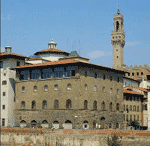
its headquarters in Palazzo Castellani. Thanks to the dedicated commitment of
the first directors, Andrea Corsini and Maria Luisa Righini Bonelli, the
Florence Museum of the History of Science was progressively transformed into a
center of conservation, promulgation and research of recognized international
importance.
Over
the last few years the museum's displays have been entirely redesigned. The
library has become the Italian center of
reference for studies in the history of sciences and techniques and scientific museology.
The Institute has held international seminaries and conferences, training
courses and exhibitions destined to itineraries in the most prestigious sites.
In addition, it has published a great number of volumes of research and
promulgation. Its educational activity has been significantly developed,
accompanied by the realization of innovative multimedia products distributed
both on Internet and off-line.
At
present, the exhibitions are displayed on two floors in Palazzo Castellani. The
exhibition itinerary has been designed according to chronological and thematic
principles. The first floor is dedicated
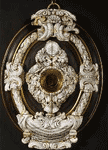
to the instruments from the Medicean collections, displayed in eleven rooms, in
which can be seen, among other things, highly refined mathematical instruments,
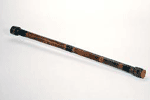
Galileo's original instruments (among them the only two telescopes surviving
from among those personally constructed by the Pisan scientist), the
instruments of the Accademia del Cimento and the extraordinary collection of
terrestrial and celestial globes, dominated by the monumental armillary sphere
of Antonio Santucci. In the ten rooms on the upper floor, evidences to the
Lorraine age are displayed. They illustrate the notable contribution of Tuscany
and Italy as a whole to the development of electricity, of electromagnetism and
of chemistry, and display the complex clockworks of portable and tower-mounted
clocks, an extraordinary series of obstetrical waxworks, the chemistry bench
used by Grand Duke Pietro Leopoldo and, lastly, the beautiful and educationally
effective machines for the demonstration of the fundamental principles of
physics, constructed by the workshop of the Museum of Physics and Natural
History.